
 Arsenal
 Aston Villa
 Chelsea
 Crystal Palace
 Everton
 Fulham
 Leeds United
 Liverpool
 Manchester City
 Manchester United
 Newcastle United
 Nottingham Forest
 Sunderland
 Tottenham Hotspur
 West Ham United
 Wolverhampton Wanderers


It might not fill as many column inches as the will-he-won’t-he Alexander Isak saga, but Liverpool’s deal with Adidas could be their most important of the summer.
T-minus four hours until the Adidas contract officially begins and most Liverpool fans with a smartphone have probably seen the designs that the German sportswear giants are set to release.
Some have speculated that the supposed images of the home, away and third kits have been deliberately leaked on social media in order to gauge fans’ reactions.
In reality, however, TBR Football understands designs were submitted some 18 months ago, well before the announcement in March of this year that Liverpool were switching away from Nike.
For a club with a global retail presence and the ability to shift millions of units, supply chains need to be primed, marketing campaigns prepared, and stakeholder feedback collected many, many months in advance. A kit launch, especially one of this gravity, is a long time in the making.
Tens of thousands of man-hours have gone into this, both at Adidas HQ in Bavaria and on Merseyside – and even a cursory look at the finances behind the partnership explains why.
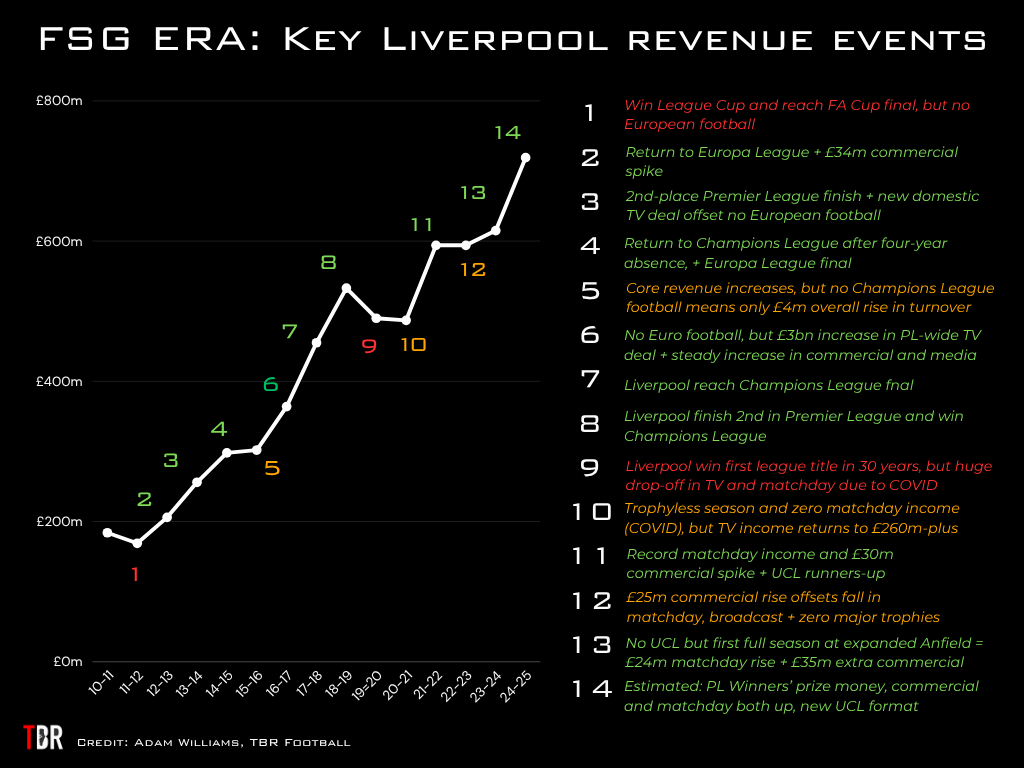
There have been umpteen love letters to the FSG business model written in the months since Liverpool won the Premier League title, and the commercial department underpins the whole operation.
In 2023-24, the last financial year for which a full data set is available, Liverpool earned £308m from merchandise, sponsorship, events and other commercial avenues. In 2024-25, expect that number to run closer to £350m. That means, for only the second time in the Premier League era, Liverpool will better arch-rivals Manchester United’s performance in the commercial department.

If talks to sign Alexander Isak from Newcastle United are successful, the £200m-plus financial commitment (in wages, fees and transfer levies) will be fully-costed against FSG’s revenue modelling for the next five years.
John Henry and his deputies in Boston like to plan three, four or five seasons in advance. With the Adidas deal reportedly lasting at least five years, that’s hundreds of millions worth of income guaranteed – gold dust for an ownership regime that has never fronted its own cash for football operations.
What’s more, the intricacies of the new deal allow Liverpool to forecast with greater certainty.
“This is a different type of deal to the one with Nike,” says University of Liverpool football finance lecturer and industry insider Kieran Maguire, speaking exclusively to TBR Football.
“Adidas are a slightly more conservative brand than Nike. They wanted to go down a more traditional route whereby it’s a bigger upfront fee plus a smaller commission on each item sold.“
As has been widely reported, the annual base fee from Nike was around £30m. With the Adidas deal, it is twice that figure, with more modest royalties.
“The benefit is that Liverpool get greater certainty. The benefit to Adidas is that if Liverpool continue to be successful, their sales go up and their cut is greater. It’s a risk versus reward analysis.”
How much Liverpool will earn from Adidas – it’s more than £60m per year…
The £60m headline figure is an oversimplification. And while the fixed vs variable elements of the contract are significant, Liverpool’s final take-home will be calculated based on a number of factors:
- Royalties – Typically 7-15 per cent of net wholesale or retail sales, depending on the contract
- Rebates – Tiered bonuses, with a flat fee or higher royalty fee paid if Liverpool hit certain sales targets, sometimes segmented by geographic market
- Performance bonuses – Unlocked by winning silverware, attaining a particular league position etc
- Inventory buyback – Manufacturer and club can share losses if stock doesn’t sell out
- Supply quota – Costs of supplying team and staff with kit can run into seven figures and is priced into the deal
Official data from UEFA shows that Liverpool made approximately £125m from merchandise and their kit deal in 2023-24. The bulk of that – we estimate around £100m – is attributable to the Nike deal.
Over the course of the five-year deal, Liverpool will therefore trouser in excess of £500m from Adidas, potentially rising to £600m depending on year-on-year growth and performances on the pitch.
Liverpool pivot away from LeBron James
One under-the-radar detail of the switch from Nike to Adidas is that Liverpool will further distance themselves from NBA superstar, who at one stage was a direct investor in the club.
James – who bought a two per cent stake in Liverpool in 2011 that he has since converted into a one per cent stake in Fenway Sports Group – is a Nike athlete and has lent his brand to Liverpool for several streetwear collections. With Adidas taking over, that is no longer an option.
“What Nike brought to the table was crossover with existing sports stars and celebrities in other industries and the leisure market,” Maguire tells TBR Football.
“As a consequence, there was a view from both parties that, if it works really well, let’s share the benefits. If it doesn’t, they share the downsides.
“Liverpool are doing fantastically well because they are a brilliantly run football club. They don’t need to merge with influencers to achieve that.”
James’ association with FSG will continue, as will his business partnership with RedBird Capital, the private equity firm who are significant minority shareholders in the Boston-based sports investment group.
- READ MORE: Newcastle will block Alexander Isak’s transfer to Liverpool if this one condition is not met
Liverpool retain merchandising rights, with UEFA PSR boost
Under the terms of the Adidas deal, Liverpool have retained their merchandising rights. In layman’s terms, they will still run the Anfield megastore, as well as their 20 other stores worldwide, where they will sell licensed Liverpool gear and retain the profits.
That is likely worth in the region of £25m per year for Liverpool, taking the revenue directly and indirectly associated with the Adidas deal over a five-year period to around £625m.
And while licensing the brand out or otherwise doesn’t move the profit needle significantly in either direction, the structure Liverpool are sticking with does have benefits in terms of Profit and Sustainability Rules (PSR).

With Premier League PSR, Liverpool have ample headroom, even with their enormous expenditure in the transfer market this summer. Under UEFA’s system, however, the margins are a little tighter.
Liverpool have no immediate concerns here either, but the squad cost element of UEFA’s rules is certainly far more prohibitive than its domestic counterpart. In this model, Liverpool are not allowed to spend more than 70 per cent of revenue plus a three-year average of player sale profits on player and manager wages, transfer fees, and agents’ fees.
The Premier League trialled a similar system on a non-binding basis in 2024-25 and, though clubs voted not to introduce it in 2025-26, it is expected to be introduced at some point.
Because it is a revenue-based system rather than one based on the profit-and-loss account, maximising turnover has implicit benefits – and, as Maguire articulates, that means retaining merchandise rights is a big plus.
“There’s a bit of a hidden PSR benefit there. From a squad cost control point of view, it makes sense to run the megastore yourself because you’re showing greater gross revenues.
“You have the cost of sales, which is ignored as far as UEFA’s financial rules are concerned because the investment is linked to gross revenue. If you outsource the store, you’re just getting the commission going into the calculation.
“For example, if we take a look at Chelsea, where Nike have traditionally run the store, if you sell a shirt for £100, Nike gets revenue of £100, you have cost of sales of £75, so Chelsea get £25 which goes into their squad cost calculation.
“If you run the store yourself, £100 goes into revenue and £75 in costs – so, you still have a net of £25 but it’s more beneficial from a squad cost perspective.”
By retaining their rights, Liverpool will also have more exclusive access to their data, which is an increasingly valuable commodity in sports business.
Could Liverpool one day take kit manufacturing in-house?
While Liverpool will bank up to £600m from the Adidas deal all told, the total revenue involved in the partnership on both sides will stretch into the billions. Therefore, wouldn’t it be better if Liverpool could take that in house?
Wolves’ owners Fosun are currently experimenting with this model. They have launched their own brand, Sudu, to manufacture the club’s kit and help maximise profits. TBR Football is aware of at least two other Premier League clubs who have explored similar arrangements.
Liverpool, however, are a different beast. They will likely sell up to 5 million units in tandem with Adidas this season, and their sales are global. That is in contrast to Wolves, for whom the vast majority of their sales are local. Liverpool’s decision to open a new store in Hong Kong last week, as well as preliminary plans for another in Japan, are emblematic of the disparity.
“Spurs bought Hummel when they were a PLC,” Maguire elaborates, “but eventually, they divested because they didn’t have the supply chain or the logistics experience.
“Adidas are used to doing this on a global scale. We think of football clubs as being huge organisations, but they’re not. If you look at the revenues of Adidas and Nike, they are so far ahead.
“Nike spend nine per cent of its revenue on marketing. Liverpool couldn’t justify that.
“If you think about it from the perspective of retailers, you might have concessions at airports and so on. They have a contract with Adidas, a contract with Nike, so you’re dealing with Adidas or Nike. To then go and have a separate deal with Liverpool? That makes it more complex. You have to decide how many square metres of space you give to them in-store – and that’s a separate deal. It all starts to get very messy.”
Liverpool and Adidas’ history will be commercially lucrative
Regardless of the technical financial details, many fans insist that Adidas just feel right for Liverpool.
The three stripes have been part of the iconography of many of the club’s greatest moments. A retro line therefore is surely in the post.
The fact that the club’s biggest commercial asset, Mohamed Salah is an Adidas athlete is a silver lining. And incidentally, so too is Isak…
Receive weekly football news and updates to your mailbox