
 Arsenal
 Aston Villa
 Chelsea
 Crystal Palace
 Everton
 Fulham
 Leeds United
 Liverpool
 Manchester City
 Manchester United
 Newcastle United
 Nottingham Forest
 Sunderland
 Tottenham Hotspur
 West Ham United
 Wolverhampton Wanderers


West Ham have received an update on the “deal of the century” from an official source.
The Hammers are currently preparing for the new season, with Julen Lopetegui‘s side currently one of the many Premier League sides touring the United States.
These pre-season exhibitions are a chance for the likes of West Ham to grow and nurture their overseas following and can prove extremely lucrative.
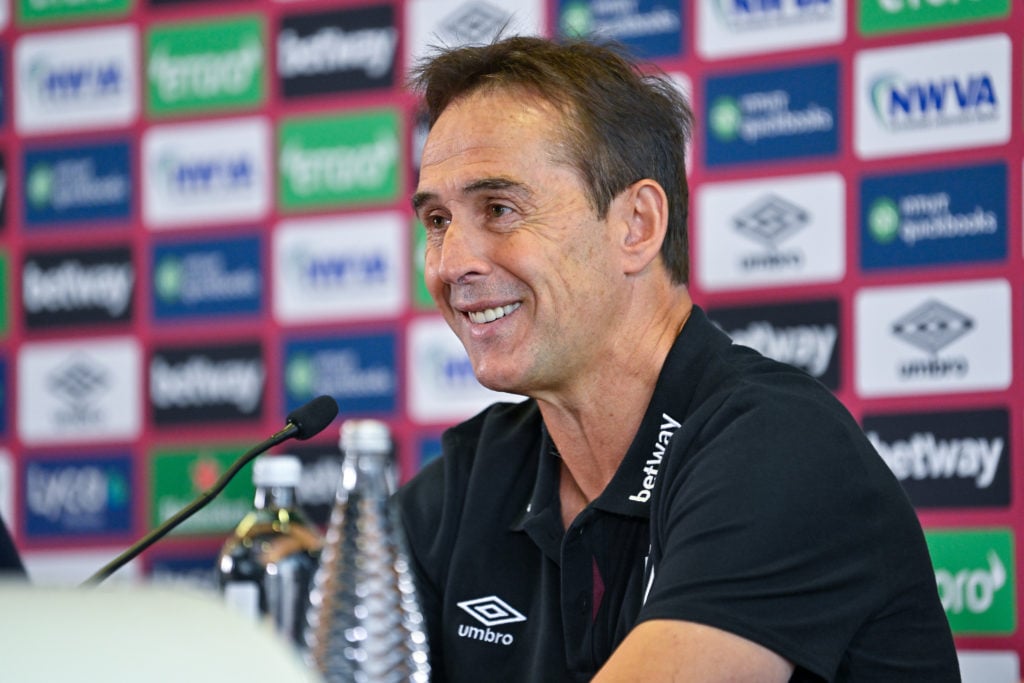
West Ham will likely bank several million pounds from the Sunshine Tour in Florida, where they lost 3-1 to Lopetegui’s old side Wolves in Jacksonville last Sunday (28 July).
The cash will come from promoter fees, merchandise sales and a cut of ticket sales.
At home, West Ham earn around £40m per season in matchday income thanks to the London Stadium, which at 62,500 has the third highest capacity in the Premier League.
However, as football finance expert Kieran Maguire recently told TBR, West Ham are limited in terms of how they can earn cash from the London Stadium given that they are tenants.
They cannot raise capacity significantly because to do so would require structural changes, which would require ownership rights.
West Ham also cannot really push the envelop with stadium-related commercial income – the first £4m of a naming rights deal, for example, would go to the landlords, with any extra split 50-50 with the Irons.
And now, the latest developments have foreshadowed what the future holds for West Ham at the London Stadium.
- READ MORE WEST HAM NEWS: West Ham have just met club’s £30m asking price for player Kylian Mbappe called ‘incredible’
West Ham get London Stadium update from Sadiq Khan
West Ham rent the London Stadium from London Legacy Development Corporation, the taxpayer-funded organisation established to manage the Olympic Park after the Games in 2012.
They pay somewhere in the region of £4m per year to inhabit the stadium, which Liverpool University football finance lecturer Maguire has previously described as the “deal of the century.”
On that basis, one might presume that there is little incentive for the club to change anything about the rental agreement.
However, it has previously been reported that the Hammers are open to the idea of buying the stadium.
But newly re-elected Mayor of London Sadiq Khan appeared to kybosh any suggestions that the East London club could buy the ground – valued at £500m-plus – outright.
As quoted by City AM, Khan said: “We’ve got to make sure that we recognise that this is a London asset. It’s owned by the taxpayers.
“We have a good relationship with West Ham. In the past that wasn’t the case. We’ve had a great Diamond League athletics event and a great Major League Baseball event there. Some great gigs as well.
“I think people need to realise that if you sell off this asset, it’s gone for good. It’s one of our crown jewels. So I’m keen to work with West Ham and other partners to make sure we can make it more successful going forward.
“This is one of the legacies of the bad deal done by Boris Johnson – we’re making do with the bad deal he left us, but it’s one of our city’s great assets. When I speak to colleagues across the globe, we can talk about an asset that we own.
“If a deal was too good to say no to then we’d have to have a conversation, but I hold it in trust for Londoners, just like the other legacies from the 2012 Games – the Copper Box, the Aquatics Centre and other great things in London.”
It is not the first time in recent days Khan has weighed in on football.
Earlier this week, the Labour mayor claimed he would be open to clubs like West Ham playing Premier League games in the United States in the future.
TBR Analysis: West Ham’s financial status amid Aaron Wan Bissaka transfer hunt
West Ham have endured frustration in the transfer market in recent days.
They have suffered setbacks in their pursuits of Kyle Walker-Peter, Noussair Mazraoui and Youssouf Fofana, although their advances to Aston Villa’s John Duran and Man United’s Aaron Wan-Bissaka appear to be making more headway.
West Ham reportedly would be able to sign 26-year-old full-back Wan-Bissaka for £10-15m.
The Hammers are one of only a handful of Premier League clubs not to have posted heavy financial losses in recent seasons.
David Sullivan and Karren Brady want the club to be self-sufficient, meaning that they are not prepared to bankroll big deficits to fund transfers.
For that reason, their pursuit of Wan-Bissaka and other targets is heavily reliant on constant revenue growth – and matchday income is central to that strategy.
If West Ham ever were to buy the London Stadium, the cost would not count towards the Profit and Sustainability (PSR) calculation.
It would also allow them to increase matchday income and commercial revenue, giving them more PSR headroom.

But while it makes sense from a footballing point of view, it does not really track from a business perspective.
And in any case, it appears overwhelmingly unlikely any time soon.
Receive weekly football news and updates to your mailbox